Category: Journal

The weekly write-ups: one shipped idea per entry, misses included.

  • Week 19: man-a-tee — the world’s most relaxed NFT-ish project

    Back in June I made a trading card of a manatee. Gray, tired, half-lidded eyes, one flipper raised in the smallest possible wave. On the back, in the monospace voice of every NFT project I ever rolled my eyes at, a certificate of authenticity: permanently etched on the blockchain, procedurally generated, hand-curated and cryptographically verifiable. I named him Captain Solve.
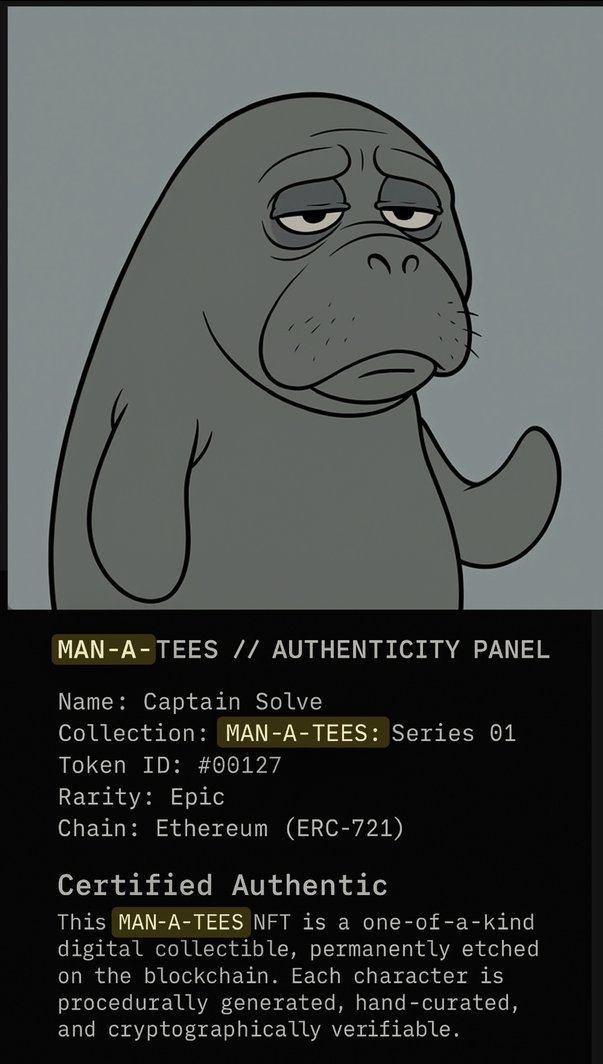
    A trading card of a tired gray cartoon manatee above a black "authenticity panel" written in mock NFT language
    Captain Solve, #00127, Epic. The card that started it, from June.

    The joke was simple. The profile-picture NFT boom ran on flexing: bored apes in yacht clubs, laser eyes, roadmaps, “you can’t afford me.” The manatee is the perfect anti-mascot. It’s slow, it eats lettuce, it owns nothing, and it looks like it has never once checked a floor price. So this week the card became a collection at man-a-tee.xyz: nine profoundly unbothered manatees with inverted rarity. Has a Job is Legendary. Mild Ambition is Ultra-rare. Gives a Damn is so rare that the manatee carrying it does not exist.

    Eight cartoon manatee portraits: one with a work lanyard and lettuce, one with barnacles, one in a party hat, one floating with its eyes closed, one holding a pebble, one with novelty sunglasses and one wearing seagrass
    Series 01. Brenda, 9-to-5 (Legendary) is top left.

    The part that took real thought was deciding what not to build. The plan in July was a free, honest mint on a low-energy chain, and I had the research done on what that would involve. Two findings reshaped it. First, Yuga Labs (the Bored Ape company) beat a copycat collection in the Ninth Circuit last year, and calling it satire didn’t help once the other project’s marks were being used. So every manatee here is original, and nothing borrows an ape, a yacht or a club. Second, under Florida law, saying a charity benefits from anything you sell counts as a charitable solicitation, with consent and registration rules attached. The cleanest answer was to sell nothing and collect nothing.

    So the mint button mints nothing. Click it and it switches to “Mint pending (indefinitely)” and admits there’s no contract, no wallet and no price. The manatees still have a cause, though, because real ones need the help: Florida manatees die from boat strikes, cold snaps and the loss of the seagrass they eat. The site links straight to Save the Manatee Club to donate or adopt, with a plain line saying we’re not affiliated and don’t touch the money. 100% of nothing goes to charity, which is the most honest thing an NFT-ish project has ever said.

    Captain Solve came from the June card. The other eight were made with Google’s Nano Banana Pro image model, using that card as the style reference, at about thirteen cents a manatee. Every card flips over to show its own certificate, including the “Chain: none (it’s a picture)” line. The domain is .xyz on purpose, since that’s where crypto projects go to announce things. These manatees are announcing that they’re not doing anything.

    The 1w1i takeaway: a parody is easiest to keep honest when it doesn’t sell anything. Every feature I cut (the mint, the merch, the charity tie-in) was a spot where the joke could have turned into the thing it was making fun of.

    — c

  • Week 18: media-incident — a 2005 homepage finally gets a job

    I’ve owned media-incident.com since 2001. For most of that time it did one quiet job: it was the storefront for my domain reseller account. The OpenSRS renewal emails carry its red m-i logo, and the website behind it was a single page with that logo and three links: Contact Us, Registration Agreement, ICANN Policy. The files are dated January 2005.

    The media-incident.com home page as it stood from 2005 to October 2026: a red outlined m-i logo and three small links
    media-incident.com, 2005 to 2026. Three links, one of them broken.

    The contact form was older than the page. It posted to a Perl script from a 2002 package called Upload Plus, and once the server’s Perl moved past 5.30 the script stopped compiling. Every submission came back as a server error. The access logs show it failing all summer. They were all bots, but a person would have hit the same wall, and nobody noticed because nobody expected anyone to use it.

    Media Incident was always meant to be the branding side of what I do. So this week it got the site it was named for: a marketing and advertising studio whose signature is naming, with the domain landed. The name does a lot of the work. A media incident is usually the bad kind of headline. The pitch is causing the good kind on purpose.

    The look comes straight from that old logo. Red was already the brand color, the m-i monogram already existed, and the dot on the i reads like a recording light. So the site borrows from breaking news: a LIVE tag, a ticker of headlines across a red lower third, condensed headline type, and services filed as “incident types.” In the naming section, a white redaction bar sits over GONE in “all the good names are gone” and lifts as you scroll to it.

    The new media-incident.com home page: a black hero with a red LIVE tag and the headline Make your brand an incident
    The same domain, rebuilt. The m-i mark survived, minus the black outline.

    The part I cared most about getting right was the work page. A new agency site wants a wall of client logos, and I don’t have client work to show. What I do have is a shelf of names. So the work page shows eight from my own portfolio, each with the brand thinking already done and a live site behind it: Emerald Cay, TerrorFish, MeanMeme, the Barfly pair and the rest. Several are for sale, and the page says so. The case file on the naming page is Smokemobile, a domain I turned into a complete BBQ food-truck brand with a logo, a voice and a working demo site, so whoever buys it gets a business instead of an address.

    What shipped: six pages at media-incident.com (home, work, services, naming, about, contact), a contact form that works again (stored off the web root, a notification to me, no mailing list), and a redirect from the old contact page. The 2005 registration agreement and ICANN policy pages stay exactly where they were, because domain customers still need them. They’re linked from the new footer.

    The 1w1i takeaway: old domains are often quietly holding something up. Before rebuilding one, find out what it still does. Here it was a reseller’s legal pages, and a contact form that had been broken for months without anyone noticing.

    — c

  • Week 17: loftscondos — “Lofts” is not a legal term

    I originally registered these domains in 2005 because the online real-estate tool I wanted to use didn’t exist yet. (It showed up the next February. It was called Zillow.)

    Twenty-one years later, the two names are the oldest real-estate domains in my portfolio, and age is the one thing you can’t buy for a domain. So this week they finally became a site: loftscondos.com, a plain-English guide to buying and living in lofts and condos, starting with my own city, Minneapolis.

    The first thing I learned is that “loft” tells you nothing about ownership. Plenty of Minneapolis buildings with “Lofts” in the name are apartments. 724 Lofts, Gurley Lofts and the A-Mill Artist Lofts are all rentals. There are even two Bassett Creek Lofts a few blocks apart: one is a 1917 condo, the other a 2019 apartment building. A buyer’s guide that mixed those up would be worse than useless.

    It turns out there’s a clean test, and it’s public. Hennepin County publishes its parcel map as an open data service. A condo building shows up as dozens or hundreds of parcels, one per unit, all sharing a plat name like “CIC NO 0313 ITASCA LOFTS.” A rental building is a single parcel typed APARTMENT. So every one of the fifteen buildings on the site carries its county CIC number, and anything I couldn’t verify that way stayed off. Listing sites don’t help here: Apartments.com lists units in Harvester, Tower and the Carlyle, but those are individual owners renting out their condos, not rental buildings.

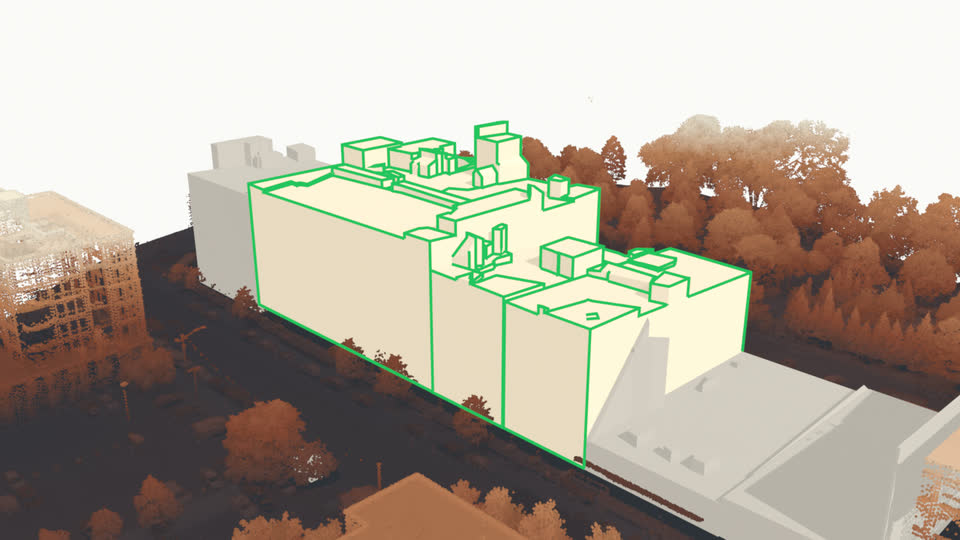
    Itasca Lofts outlined in green in a 3D model built from public lidar data
    Itasca Lofts (built 1886), the first big warehouse-to-condo conversion in Minneapolis, in 1981. A model from public lidar, not a photo.

    The second thing I learned is that I wasn’t allowed to show the buildings the way I wanted. Every building page wanted a slow orbit, the kind of Google Earth fly-around you see in real-estate videos. Google’s terms rule that out for a commercial site, and so do Apple’s, Mapbox’s and Cesium’s. I own a small drone, but flying it for a commercial site needs a Part 107 certificate, a Minnesota commercial license and insurance, none of which I have yet. So I built the orbits from public data instead: the USGS flew the river corridor with lidar in 2022, the city publishes building footprints, and an open-source tool called roofer turns the two into simple 3D models. Each building page has one. They’re clearly models, not photos, and they’re entirely mine to use.

    The guides are the other half of the site, and they were the most fact-checking I’ve done on this project. Condo lending changed a lot in 2026: Fannie Mae and Freddie Mac dropped their owner-occupancy test in March, capped the per-unit insurance deductible in July, and tightened reserve-study rules in August. FHA didn’t follow on owner-occupancy. A guide written from what I “knew” last year would have been wrong in four places.

    What shipped: four guides (loft vs. condo, buying and financing, HOA living, loft quirks), a Minneapolis section with fifteen verified condo buildings across the North Loop, Mill District, Downtown and Northeast, and a question form that only promises an email reply. No phone field, no “we’ll connect you with an agent.” Real-estate lead generation has real rules (RESPA, fair housing, consent for calls and texts), and I’d rather have a lawyer read it before the site makes any promise it can’t keep. lofts-condos.com now redirects to the main site.

    The 1w1i takeaway: sometimes you need to get creative with the methods at your disposal. I couldn’t use Google’s 3D, couldn’t fly my drone and couldn’t trust the listing sites, so a county parcel map and a government lidar survey did the work instead.

    — c

  • Week 16: mntunes — the calendar I didn’t build

    mntunes.com has been sitting in the portfolio for years with a simple promise baked into the name: Minnesota music. The obvious thing to build is a gig calendar. Everyone wants to know what’s playing tonight, and a calendar is the kind of site people come back to. So in June I decided that’s what this would be: a “what’s playing” calendar for the whole state, with deep venue profiles alongside it.

    This week I shipped the venue profiles and deliberately left out the calendar.

    The reason is boring, and I think it’s the most useful thing I learned all week. A calendar is only as good as its data, and the data belongs to the ticketing companies. Ticketmaster’s developer API is free and generous, but its terms rule out exactly what a calendar site does: poll in the background, keep the listings, and make money around them. Worse, it wouldn’t cover the rooms that matter. First Avenue and its family of clubs sell through AXS. The Dakota and the Cedar use Etix. A Ticketmaster-fed “Minnesota calendar” would list the arena tours and skip the Turf Club, which is backwards. I’d be shipping something that looked complete and wasn’t.

    So each profile does the honest thing instead and sends you straight to that venue’s own calendar. The home page says why there’s no combined calendar yet. It’s less impressive and it’s accurate.

    The real work turned out to be fact-checking. My draft notes were written from memory, and memory is a confident liar. I “knew” Fine Line had closed and reopened; it has run continuously since 1987. I had Palace Theatre at 2,500; it’s about 2,800. I’d assumed the First Ave clubs used Etix; they’re on AXS. Rock the Garden, which I’d have put in a festival guide without thinking, ended in 2022. The Basilica Block Party is gone too. Duluth’s West Theatre closed temporarily in July during a foreclosure, so it isn’t on the site. Moondance Jam was sold this year and its future isn’t settled, so the site says exactly that. A music guide that confidently lists dead festivals is worse than no guide.

    What shipped: thirteen venue profiles, from the 250-person 7th St Entry to the 8,400-capacity Armory (where Prince shot the “1999” video), plus Duluth’s NorShor, Sacred Heart and the Bayfront stage. There’s a statewide festival guide, because outside the metro Minnesota’s music mostly lives at festivals in Detroit Lakes, Brainerd, Winona and Duluth. And there are two pages about the unglamorous business of a show. One covers the 2% tax Minnesota withholds from out-of-state performers, which is a surprise to most touring bands. The other breaks down where a cover charge goes: songwriter licensing, state sales tax, and Minneapolis’s extra 3%.

    The 1w1i takeaway: the ambitious version of an idea often depends on someone else’s data, and their terms decide what you can build. The version you fully control, like a careful profile of a room, is smaller but it’s yours, and it’s true. I’ll build the calendar when I can build it honestly.

    — c

  • Week 15: My Lunch with Kevin Smith — dinner, no podcast

    In January 2011 the Nerdist podcast recorded a live episode at SModcastle, the little Los Angeles theater Kevin Smith had opened the year before as the first stage built for podcasting. The episode came out on January 17, simply titled “Kevin Smith,” and somewhere in it he did what he spent that whole era doing: telling everyone within earshot to start a podcast. I won’t put words in his mouth. The gist, roughly, was that if you have a microphone and something to say, you have a show.

    The idea took that advice as literally as it could be taken. There are a lot of Kevin Smiths. Enough that right now, somewhere, one of them is spelling it for a pharmacist who says “like the director?” So: a podcast where every guest is a different real person named Kevin Smith. Lunch gets delivered, a sponsor pays for it, and we spend half an hour on the name, the question they always get, and who they actually are, which is the part that matters. None of the guests directed Clerks.

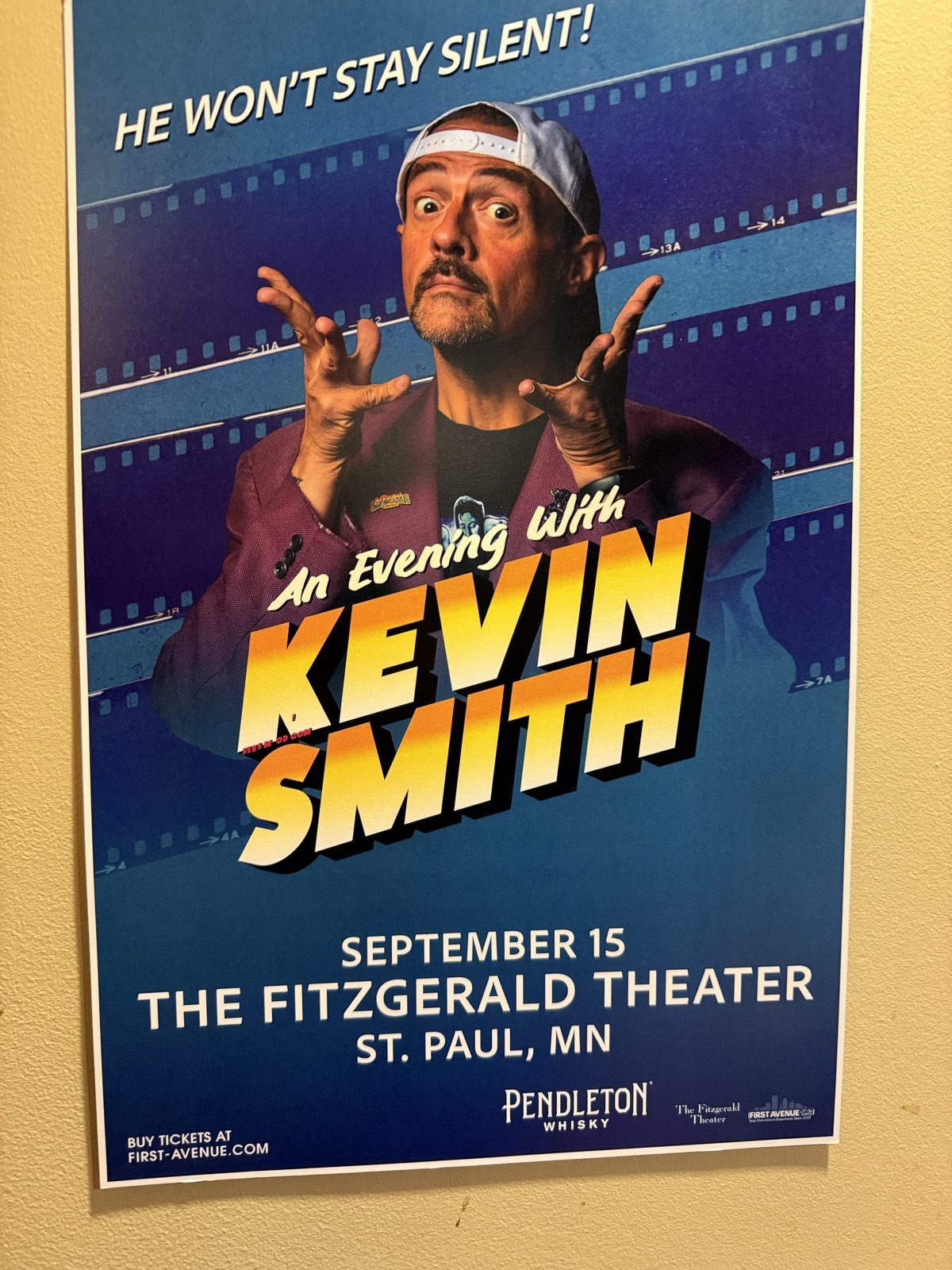
    The week had an anchor before it had a plan. On Tuesday, September 15, Tyler and I were in a box at the Fitzgerald Theater in St. Paul for An Evening with Kevin Smith, the actual one.

    Poster for An Evening with Kevin Smith, September 15, The Fitzgerald Theater, St. Paul
    The poster. He won't stay silent, and he didn't.

    So the lunch became dinner, and the one Kevin Smith we spent the evening with was the one the podcast was never going to book.

    Kevin Smith on stage at the Fitzgerald Theater, seen from a box above the stage
    The view from our box. The real one, for reference.

    Then I decided not to make the podcast. I think I’d be OK at interviewing people. But for this idea to really work, OK isn’t enough. Every episode lives or dies on the conversation with a stranger who has nothing to promote, and that takes an interviewer who has put in the time to become great at it. I can’t give it that time right now, and it deserves more than a show I’d make between other things.

    That’s the first time a week has ended with “no” instead of a launch, and I’m glad the plan already said no domain and no landing page. mylunchwithkevinsmith.com is still available. I didn’t buy it, so the only thing this idea cost me was a theater ticket, and I’d have bought that anyway.

    If someone else wants to make it, please do. Book the first Kevin, get a sponsor to buy lunch, and have every guest name the next Kevin Smith so the show builds its own network. I’d be a subscriber.

    The 1w1i takeaway: one week is enough to learn whether you’d be great at something or just OK. Knowing which ideas deserve more than you can give them is a result too.

    — c

  • Week 13: 3-13 — eleven rounds, two decks, one argument

    Three Thirteen is the card game at our table. Eleven rounds; the deal starts at three cards and grows to thirteen; whatever number just got dealt is wild. It teaches in one round and lasts all evening, and for years the scorekeeping has run on paper pads I print myself, which works right up until someone disputes the math in round nine and the pad has no opinion.

    This week’s domain isn’t mine. That’s a first. 3-13.info belongs to Tyler, and it’s the best-named domain this project has touched: the game is literally called 3-13, and the name plays it back with a hyphen. My shelf full of dormant domains had nothing that fit better, so week thirteen became a collab week — his name, our build.

    The build is a scorekeeper for iPhone. Add the table, give everyone a face — a selfie, a photo, or an initialed circle for the committal-averse — and the app quietly runs the ceremony: whose deal it is (the dealer’s avatar wears a badge that advances itself), what’s wild this round, who’s leading (a small crown, lowest score, because low wins). Tyler beta-tested it the way you hope a partner will, which is to say he sent a list. Blank scores must not mean zero. Names must survive deletion. A rematch button. Groups, so “just us two” has its own all-time standings. All of it went in the same day, because when your user is three feet away the feedback loop is just dinner.

    The site carries the other half: the rules written plainly, the scoring table, the printable score pads (the paper ones, ennobled), and one page for a physical gift set that deliberately has no price, because inventing one before Tyler decides on production would be fiction with a buy button.

    My favorite shipped feature is a sentence. With two decks in play, three identical nines — club, club, diamond — is a legal set; a run can never repeat a card. That ruling, per the authoritative rules archive, ended an argument that had survived multiple game nights at our table. It’s now printed on the site and enforced by the app. Most software ships features; occasionally it ships a verdict.

    Honest state of the week, updated September 23: the app is on the App Store, free, and the site at 3-13.info points at it. It arrived six days late for a reason worth writing down: App Store Connect will approve and release a new app into zero countries and never say so. The listing sat “Ready for Distribution” and invisible until the territory list existed. Tyler turned the key on the domain; the icon is his to draw, the gift set is his to price, and neither needs a nudge. It’ll land when it lands.

    The 1w1i takeaway: I spent eleven weeks pulling names off my own shelf, and the best fit yet was on someone else’s. Build for a table you already sit at, and let the domain belong to whoever loved the game first.

    — c

  • Week 12: minneapolos — the pun was the easy part

    Some domains get bought because of a plan. minneapolos.com got bought in January 2024 because the word made me laugh: Minneapolis with polos hiding inside it, a whole product category folded into a city name like a note passed in class. It has sat on the shelf for two and a half years waiting for me to take the joke seriously. This week I did, and it turns out the pun was the easy part.

    The idea is embroidered polos with small Minneapolis icons on the chest. Not the big-graphic hometown tee — there are good people making those already — but the quiet version: a stitched mark about the size of a drink coaster, local pride at lapel-pin volume. The polo your kids should have gotten you. It jumped its original late-September slot for exactly that reason: this is a gift, and gifts have a runway that starts in October and doesn’t wait.

    The most useful work of the week looked nothing like building a store. It was trademark research, and it works like a photographic negative: list everything Minneapolis you can’t stitch, and look at what’s left. You can’t touch the Prince symbol — the estate holds it. You can’t do the First Avenue stars, the team marks, or, and this one surprised me, the Spoonbridge and Cherry, because a sculpture carries copyright the way a logo carries trademark. What’s left is the Stone Arch Bridge, the loon, the skyline, the North Star — public landmarks and state symbols, the quiet stuff only locals clock. The lawyers pushed me into better taste than I started with. The four icons that survived the cut are a better product line than the ten I brainstormed.

    Here’s the honest-scope part. The store that shipped this week sells nothing. There’s no checkout, because there’s no shirt yet, and I’ve decided to stop pretending that’s a bug. Print-on-demand embroidery has two serious platforms, both of which will happily take my money today, and the only way to know whose stitching deserves the chest of a fifty-dollar polo is to order samples from both and put them side by side. So the site does the one thing a site can truthfully do at this stage: it shows the four designs, states an expected price, and takes an email address. First-run pricing and first pick go to the list, in order. If the list stays too small to stitch a run well, the page says I’ll tell you that instead — and I will.

    Even the product photos are honest about not being photos. Every shirt on the page is a drawing — a flat-lay illustration with a little magnifying loupe showing the stitch detail — and the page says so in plain text, because the illustrations are also the actual embroidery files-in-waiting. The same four SVG marks on the site go to the digitizer when the samples get ordered. The mockup is the artwork. I like when the demo and the deliverable turn out to be the same file.

    The 1w1i takeaway: physical products invert this project’s premise. Software ships in a week because the marginal copy is free; a shirt ships in a season because thread is real. What a week is actually for, with atoms involved, is shipping the demand test — the storefront, the designs, the list — before a dollar goes to inventory. Eleven previous weeks taught me to ship the smallest true thing. This week the smallest true thing is a promise with a sign-up sheet, made carefully enough to keep.

    — c

  • Week 11: reviewatron — the idea that had to earn its way back

    Week 11 was supposed to be powerballer: a parody blog so thoroughly pre-built that shipping it from a cruise ship required exactly one command. I did not run the command. There’s a lesson in that which has nothing to do with bandwidth and everything to do with appetite: a joke you were delighted by in July can feel weightless in August, and the one-command ship you don’t feel like running is the cadence telling you something. The site stays staged. The slot went to something that had to fight its way back onto the list.

    reviewatron was on the original queue as “affiliate review blog, pick a niche,” and when I re-evaluated the whole idea bank in July it got demoted, deservedly. A generic review blog with no angle is the most default idea on the internet. What put it back on the board was changing what it actually is: not a blog that reviews things, but a loop. Brands send a product. We review it honestly, on the record, disclosure up top. Then we give the product away to readers. The review earns the audience, the giveaway grows it, the audience earns better products to review. The site is just the bench the loop runs on.

    Honesty is the entire asset, so the design says so out loud. The identity is a test bench: graphite and off-white, safety orange for the needle, monospace for anything measured. Every review opens with how we got the product — bought it ourselves, or sent free and disclosed — and closes with an analog meter and a stamped verdict: KEEP, FINE, or SKIP. No affiliate link ever moves the needle, and the site’s legal pages commit to that in writing rather than burying it in a footer.

    Due diligence had one genuinely fun turn. There’s an active @reviewatron on Instagram, and before building a brand on the name I finally looked: it’s two women from Kent with a film and TV podcast. Different continent, different niche, no domain. We can share the word. Their reviews are about cinema; mine come with a gauge and a giveaway. The handles here go by @reviewatronbot, which suits a site whose mascot is a measuring instrument anyway.

    What shipped this week is the bench, not yet the products on it: the hub live on reviewatron.com, the reusable review template, the disclosure and privacy pages, and the pitch page for brands. The first written reviews and giveaway number one are next week’s work, because they need real products from my actual shelf and honest hours of using them — the one part of this loop that can’t be pre-built, and shouldn’t be.

    The 1w1i takeaway: ideas aren’t fixed quantities. The same domain held a dead idea in July and a live one in August, and the difference wasn’t effort or timing — it was finding the loop that makes the thing feed itself. When an idea gets demoted, the interesting question isn’t whether to delete it. It’s what it would have to become to deserve the slot back.

    — c

  • Week 10: cve.social — the week the ocean won

    Week 10 had a plan, and the plan had a certain glamour to it. I was going to stand up my own corner of the social internet from a deck chair in the middle of the Atlantic: a Bluesky handle that is just my domain, and behind it a small self-hosted fediverse server humming on a rented box in Germany. Starlink made it technically possible. I want to be clear that the technology held up its end. The satellite constellation performed flawlessly. The bottleneck was the guy in the deck chair.

    Here is what I learned about provisioning servers on a cruise: you don’t. Not because the bandwidth isn’t there — it is, eerily so — but because a ship is a machine purpose-built to dissolve exactly the kind of intention that server provisioning requires. Every step needs an account, a payment method, a two-factor code, a decision. The ship needs you to look at the ocean. The ocean wins. It should win. That’s what it’s for.

    So Week 10 shipped nothing on Friday, and I’m writing this from dry land almost two weeks late. What finally shipped is deliberately small: cve.social now has a front door. A dark little identity card that says who lives here — Carl, the person, not the company — with three doors on it, all honestly marked COMING: the Bluesky handle, the fediverse address, the mailbox. The one link that works today points away from the page, to the business site, which is the entire point. The person and the company get separate front doors, and mixing them up is how you end up over-exposed in both directions.

    The idea underneath is worth the wait. On Bluesky your handle can be a domain you own, which means identity stops being something you rent from a platform and starts being something you hold the deed to. The handle IS the domain. For a project that’s spent ten weeks pulling dormant domains off a shelf, this one is different in kind: the domain isn’t the address of the product. It’s the product.

    The 1w1i takeaway: a weekly cadence generates two ledgers — the things you shipped, and the truth about when. The streak is only worth keeping if the second ledger stays honest. Week 10 is a miss, recorded as one, with the smallest true thing shipped late and the rest still COMING. I’d rather show you that than a Friday timestamp with a story behind it.

    P.S. — August 27. This post sat in drafts long enough to earn a correction, and it’s one I’m glad to make: the rest of cve.social arrived, and it arrived in a single afternoon. The Bluesky handle verified, so the domain is literally my username now. The mailbox came alive, and its first job was catching its own verification codes. And the part the ocean took — the self-hosted fediverse server — is running on a small box in Nuremberg: a mastodon.social account searched for @cve@cve.social and the follow just landed. Every COMING label on the front door is gone — and so is the business link, because the card reads better as all person, no company. Some weeks you lose to the ocean. Apparently you get them back on land.

    — c

  • Week 9: cabinchoice — the name wanted the woods

    Some weeks you build the idea you planned. This week the domain overruled the plan. cabinchoice.com has been on the queue since the start as the flagship: cruise-ship cabin reviews, because picking the right stateroom is the best decision a cruiser makes after picking the ship, and the official deck plans are no help at all. I’d even built the bones in June: a census of every stateroom on a Celebrity Edge-class ship, all 1,355 of them across seven decks, with my own rendered deck plan. It never shipped. Something better happened instead.

    The hook was always personal. We’re back on the same ship, so what cabin did we love five years ago? That became an iPhone app, and then the app refused to stay small. It grew a crew logbook, a port diary, and a way to measure how rough the sea is by laying the phone flat and letting the motion sensors watch the ship breathe. Somewhere in there it stopped being about choosing a cabin at all, so it got its own name, Cruisery, its own domain, and a spot on TestFlight. The stateroom census will find its home over there eventually.

    Which left cabinchoice.com holding a parked page and a question. Here’s the thing I finally admitted: the name never said cruise. Say “cabin choice” to anyone who hasn’t spent weeks inside my head and they picture pine trees, a lake, an A-frame with smoke curling out of the chimney. The name was bought for one idea and was always better at a different one. This week I let it have its way.

    So cabinchoice.com is now the start of an Airbnb-type site for cabins. The real kind. Find one, book one, or list the one you own. What shipped is deliberately small: a coming-soon page with a waiting list that asks one question beyond your email, which side of the door you’re on. Book a stay, list a cabin, or just keep me posted.

    That one question is the whole strategy. Marketplaces die of empty supply; the graveyard is full of two-sided ideas that built the product first and found out there was only one side. The list is an instrument. If “book a stay” piles up while “list a cabin” sits at zero, the idea has answered, and the answer cost a page instead of a year.

    The page itself is split down the middle because the business is: stayers on one side, owners on the other, one list at the bottom. The cabin is hand-drawn SVG, sun and chimney smoke and all, because opening a brand about honest cabins with stock photos of someone else’s would start it on a lie. And the doorman is forty lines of PHP I’ve grown fond of: a hidden field only robots fill in, a timestamped token that rejects any form completed faster than a human can type an email address, and a per-visitor cap that locked me out during my own testing on the fourth signup. Being turned away by your own bouncer is an underrated form of quality assurance.

    The 1w1i takeaway: I used to think naming ran one direction. You have an idea, you attach a name. Week 9 says it runs both ways. The app outgrew its name and left home; the name stayed put and turned out to know exactly what it wanted to be. Listen to the domain. It was telling everyone but me all along.

    — c